
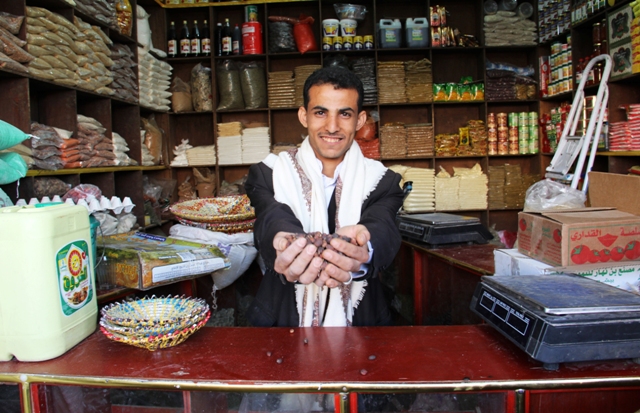
Musty Kamal
What makes this article difficult is that I cannot possibly throw around the term “ceteris paribus” given Yemen’s current volatile and muddled state. The term is one that allows economists to map out a linear path to growth whilst ignoring some factors that may be of secondary importance in relation to the predominant economic trend at hand. Alas, in Yemen, one cannot exclude the largely exogenous factors disseminating a country that given peace, restructuring and liberalization could enjoy a prosperous future.
The obvious and largest destructive force in Yemen is War. The international relations aspect of the conflict is complex, but the cold hard consequences are not. 80% of the country’s population is in need of aid. Let that sink in. If the situation was transposed on to the UK, 51 million people would be in need of emergency relief. Prior to the conflict, upwards of 80% of the country’s consumer needs were met by imports. However, the near destruction of 8 ports, 500 roads, 150 reservoirs and 350 major market places has meant that the people of Yemen will find it increasingly difficult to get the goods they need, most of which are extremely basic.
It is widely acknowledged that small enterprises are the life support of any economy. Due to largely physical damage, 35% of businesses have closed down since the conflict began. This has disproportionately affected women, who prior to the crisis only owned a third of Yemen’s businesses, but 50% of these have stopped operations. Given the institutional boundaries that Yemeni women face on a daily basis, this conflict has set back their struggle indefinitely. Income inequality is another schism in Yemen’s social fabric, which makes recovery even harder. The bottom quartile of the population only holds 10% of the country’s wealth.
Remittances also play a significant part in Yemen’s economy, with estimates ranging from 10-40% of the pre-conflict economy being composed of remittances from the large numbers of unskilled Yemeni workers that sent back some of their income from neighbouring Gulf States now do not have a secure route to do so anymore. This has left their families in a quandary but also many businesses short of demand.
The aid situation is dire in Yemen, although it is widely recognized that aid is no secure route out of the quagmire, it is most definitely necessary in stabilizing the current situation. There have been countless situations where medical supplies have not reached their destination due to “access issues,” the best example probably being the much-needed 25 tonnes of crucial medical supplies that was waiting on the borders of Taiz for several months before it found a way in. Moreover, geopolitics has spilt over onto the race for aid. Many charities have highlighted the commitment of several gulf countries to provide certain amounts of aid, which have not come through.
I have spent such a large amount of time painting the horrible picture that many have to live out daily. But where is hope? What makes this question difficult is that Yemen’s future, as has been the case for such a long time, is not entirely in its own hands. The nation’s domestic politics has been dominated by exogenous forces for such a long time and add this to clear geographic and sectarian divides which pre-date the conflict; we are left with many obstacles.
The key to an economic recovery is a trust in the “legitimacy and authority of state,” from this point the other tenants of rule of law and economic reconstruction can flow. What is encouraging is that the vast majority of the population have no appetite for conflict, but what is discouraging is that the aforementioned inequality gap has left the richest in society playing with the financially disenfranchised.
The path to recovery will be long for Yemen, but if power is wrestled back from those with vested interests we will see a prosperous and peaceful nation in our lifetimes.
Musty Kamal is an Economics and Philosophy Graduate from LSE. He is currently a Human Rights activist and foreign policy commentator
 yemengrowthforum.org